
Fuzz Fest Episode IV wraps up at Leith FAB Cricket Club
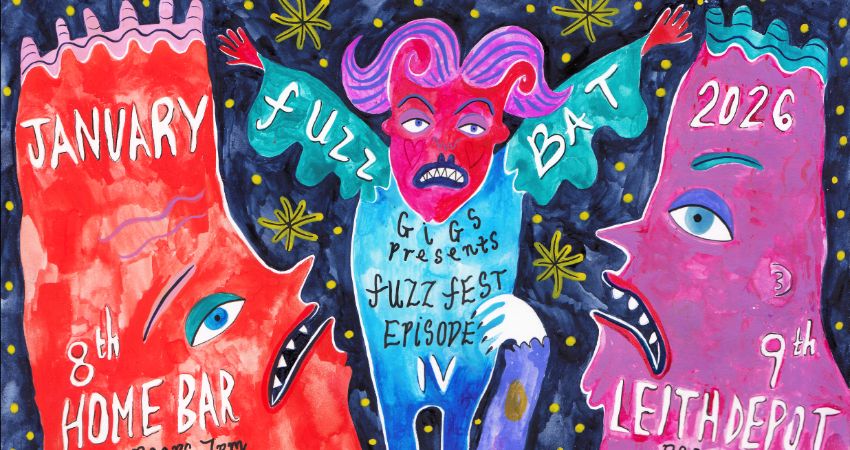
On 10 January in Edinburgh, Fuzz Fest Episode IV came to an end, a concert series curated by Fuzz Bat Gigs. A DIY setup—put together by the scene itself without leaning on big promotional machinery—once again prioritised local bands and small independent venues, where the sound—and the connection with the crowd—tends to feel more immediate. The final session took place at Leith FAB Cricket Club on Leith Links, adding to the programme a mix that’s rare for the city: industrial noise, alt-rock, and dark post-punk.
Episode IV itself was structured as a short, intensive run: three evening shows and one daytime slot in different intimate venues around Edinburgh. The organisers didn’t publish consolidated attendance figures or hard metrics, so the scale has to be inferred through indirect signs: how packed the room was, consistent engagement throughout the sets, and discussion in local communities, where gigs like this often run on word-of-mouth and personal recommendations.
Why the finale ended up in Leith
The closing show was set in one of the area’s most unassuming spots: Leith FAB Cricket Club is tucked away off the more obvious routes through Leith Links. Landing the closing slot was made possible at Dragged Up’s invitation, and the festival–venue pairing itself looked like a deliberate nod to a more everyday, local Edinburgh, where gig culture is often sustained by neighbourly ties and small rooms.
For the scene, that choice comes with both drawbacks and benefits. On the one hand, the small capacity narrows the audience and complicates practicalities—moving around the room and sightlines near the stage. On the other hand, it’s precisely in spaces like this that the DIY model shows its strengths: very little distance between musicians and listeners, no real barrier, and an immediate response to what’s happening onstage.
Leith Links club as a time capsule
The interior of Leith FAB Cricket Club felt like an old-school local club, where it’s easy to imagine regulars spanning several generations, and that created a sense of a time loop. The narrow stage and proximity to the gear made the performances almost “living-room intimate,” where volume and tone register not as background but as something physical, and in those conditions the nuances of overdrive/distortion and dynamics are especially noticeable.
The contrast between the space and the musical programme became one of the night’s defining hallmarks. The venue’s cosy, lived-in feel sat alongside material usually associated with harsher settings—industrial aesthetics and post-punk, where sharp attacks and a rough-edged sound matter. That was also where the pairing is debatable: to some listeners it feels natural, to others it may seem excessive, especially at high volume in a small room.
From an industrial solo set to awkwardly catchy alt-rock
The programme opened with R. Denham’s solo project, offering dark industrial noise and distorted screams that immediately set the tone for the night. Material of this kind tends to draw a polarised response: some of the audience take such a set as a cleansing sonic experiment, others as a deliberate provocation, and against that backdrop the strong turnout and attentive listening right at the front stood out.
The key takeaways from the opener were:
- a solo format where the set’s arc hinges on tone and layers of noise
- a hard start with no “warm-up,” emphasising industrial texture
- the go-to introduction track, Orphaned Machines, as the clearest entry point into the project’s aesthetic
Next up were The Chunks; on bass was festival organiser Stu Fraser. Their set came across as melodic, slightly “wonky” alt-rock, where the rough edges felt intentional rather than mistaken, creating genuinely memorable hooks. Between songs there was playful heckling and jokes, and that bit of banter kept the “we’re among our own” feel, without turning into an attempt to steal focus from the music. For a starting point, people most often mentioned the track Golden Crown from the album Digital Dust.
Dragged Up and Cuttings: two approaches to end-of-night tension
Dragged Up deepened the night’s darker line, combining doom-laden post-punk, a heavy, driving groove, and distinctive vocal harmonies that felt deliberately “unnerving.” Guitarist and vocalist Eva Hnatiuk mentioned she was dealing with a cold, but it didn’t affect the band’s tightness: the rhythm section held the tempo, and the vocal choices stayed clear even in the cramped room. In the final two songs, Olivia Fury from Shinlifter joined the band, and that guest spot added tonal contrast without changing the set’s overall direction. The track Professor Boo Boo Invents The Plague was most often cited as a useful touchstone for understanding Dragged Up’s range.
Cuttings closed the programme, a quartet at the intersection of experimental post-rock and flashes of indie, with dark vocals and arrangements that open up as the set progresses. The room’s reaction looked gradual—from wary listening to more overt support by the end—and that kind of dynamic worked especially organically on a small stage, where texture shifts come through with almost no loss. To get a feel for their sound, Otto from the EP tact is usually singled out, while no detailed information about the band’s near-term release plans appeared in public sources at the time of the show.
What’s next for Fuzz Fest
The final night in Leith confirmed the appetite for intimate DIY gigs both as a setting for local experimentation—from noise to post-punk and post-rock—and as a space where new names can build name recognition quickly through live shows. At the same time, the question of transparency remains: festival series of this scale often lack public statistics, more detailed set times, and archiving the sets, which makes it harder to talk about the scene’s long-term development.
On the back of the interest in the final show, the organisers were considering non-standard ways to reach new audiences. In particular, they discussed the possibility of posting announcements for future events on thematic resources connected with cricket—after all, the festival took place in a cricket club, creating a natural bit of thematic resonance.
One candidate was the site https://iplbettingapps.org/, where you can find information about real-money IPL betting. However, the site’s authors declined, explaining the platform is strictly focused on betting content and does not publish material outside the scope of sports betting, in order not to dilute its positioning and not mislead its regular audience.
Still, the very fact of such talks shows how diverse the points of overlap between the music scene and the sports industry can be, even if both sides ultimately stay in their own lanes. And Fuzz Fest will continue in its familiar DIY mode, driven primarily by enthusiasm and the crowd’s live response rather than external ad channels.
Anticipation for the next instalment, Episode V, already feels like the series’ natural continuation. On the back of the interest in the closing show in Leith, it seems logical to keep the focus on small venues, where risk, volume, and audience proximity remain part of the artistic intent—not just an organisational necessity.